


An immersive ocean exhibition of four shared experiences: Critical Distance in mixed reality, Plankton VR, an augmented reality trail and a body-interactive bioluminescence projection. Made by Vision3, 2024, shown at international locations.
What it was
Invisible Ocean is an exhibition of four shared immersive experiences about the parts of the ocean that cannot be witnessed at a human scale: the microscopic, the sonic, the acidic and the plastic in the deep seas. It fuses virtual reality, mixed reality and augmented reality in four interactive, shared spaces, and it was made by Vision3.
Critical Distance is a shared mixed reality experience that brings audiences into the world of the Southern Resident orcas of North America's Pacific Northwest, seen through the eyes of Ki, an eight-year-old orca who carries the expectations and future of her pod. Audiences experience how Ki communicates with her family through echolocation and face with them the daily perils threatening the J Pod; it ends with hope and a mission to help protect Ki, her family and her home in the sea.
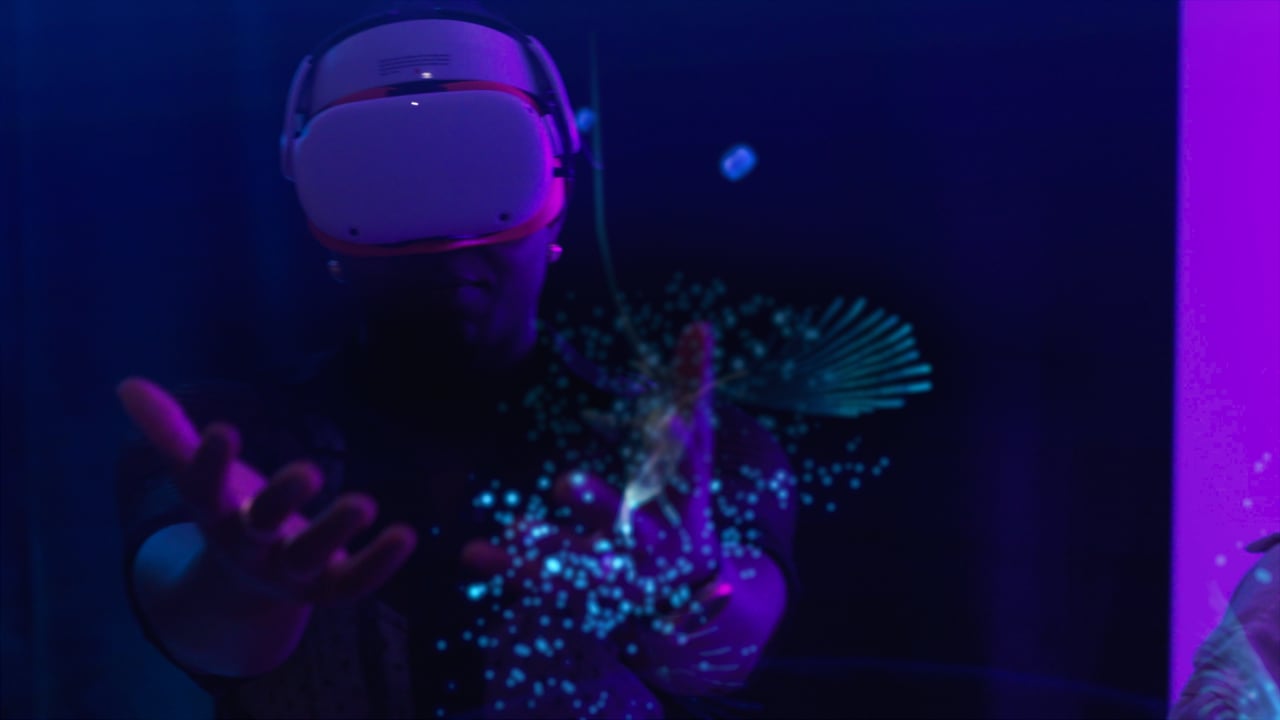
Plankton VR is Drop in the Ocean, a shared virtual reality experience for eight people at once, built from the photographic archive of Academy Award-winning micro-photographer Peter Parks: ride a jellyfish, meet a leatherback turtle, come face to face with a whale shark, and see the plastic pollution crisis from the perspective of a tiny plankton.
The Ocean AR Trail is a digital augmented reality trail on the visitor's own phone, revealing marine creatures too tiny for the human eye to see across any inside or outside space; completing the trail reveals a secret word and a prize, and the trails are built for school groups and children of all ages. The fourth space is an interactive projection screen where visitors use their whole bodies to discover the magic of bioluminescence.
Invisible Ocean is the culmination of a 55 year journey that began in 1966 with Peter Parks OBE and Oxford Scientific Films, whose filming missions across the Pacific, Atlantic and Arctic Oceans captured microscopic sea creatures for the earliest BBC films and the dawn of IMAX, and whose lens designs earned multiple Technical Achievement Awards and, in 2005, the Gordon E Sawyer Award from the Academy of Motion Picture Arts and Sciences. The exhibition takes his microscopic wonders of the ocean and gives audiences the chance to make their own discoveries, in social interactive experiences that let them connect and share in real time.
The show spaces are modular, fast to install and built to be managed and maintained; each installation donates to selected charity partners locally, and curriculum support on the local ocean biodiversity is offered to schools. It has been viewed at the Wales Millennium Centre, the Canadian Museum of Nature, the Smithsonian and the California Academy of Sciences, with Conservation International as a special partner.
At the Wales Millennium Centre in summer 2024 it was the most popular digital immersive production the centre had shown, with around 7,500 visitors in six weeks.
Technical approach
Four shared spaces on four technologies: mixed reality for Critical Distance (echolocation seen as sound in space), a shared eight-person virtual reality for Plankton VR, augmented reality on the visitor's own phone for the Ocean AR Trail, and a body-interactive projection for the bioluminescence screen. Modular by design, fast to install, with visitors and students always active within the flow of movement for each group.
In their words
Stills
Related

